



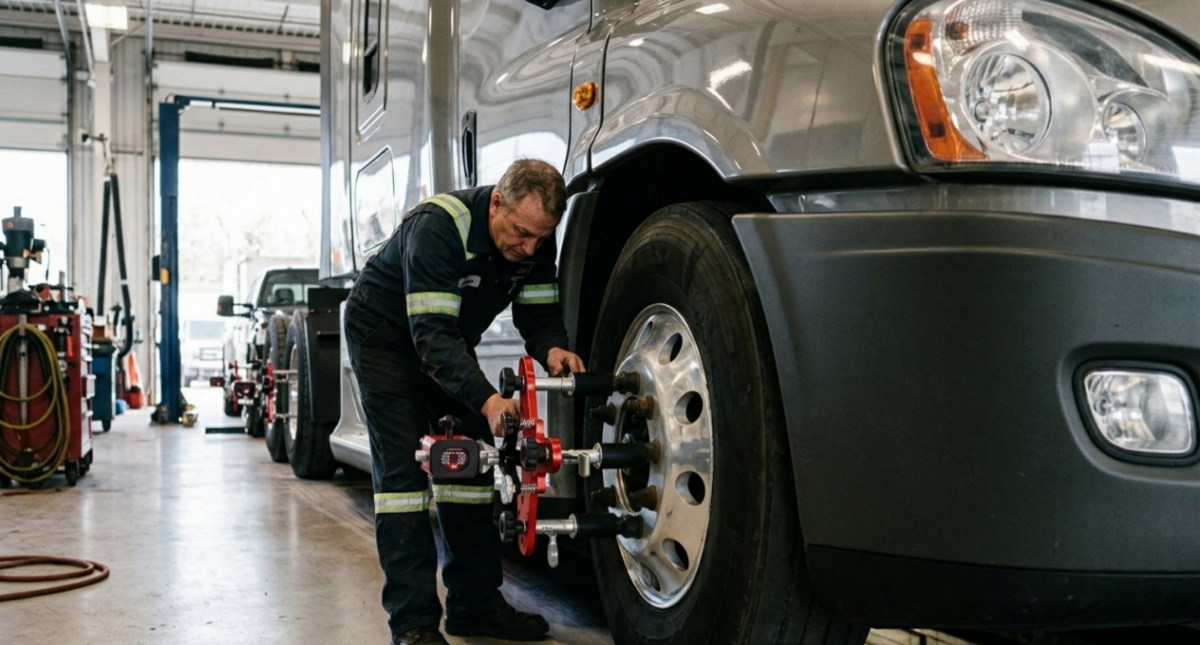
Running a profitable commercial vehicle workshop or managing a large fleet requires more than basic mechanical repairs. Today, BS6 emission norms and rising operational costs demand preventive maintenance tools. Investing in an advanced Wheel Alignment in Modern Workshops alongside precision wheel alignment equipment is essential for keeping heavy trucks and buses on the road. When workshops combine a reliable Wheel Alignment with camera-based alignment systems, they solve two of the biggest expenses for fleet operators: exhaust backpressure failures and premature tyre wear.
In this comprehensive guide, we will explore why heavy vehicles require wheel alignment, how aftertreatment maintenance works, and how equipping your garage with the right machinery increases workshop profitability.
Why Heavy Vehicles Require Wheel Alignment Regularly
Heavy commercial vehicles—such as multi-axle trucks, trailers, and intercity buses—carry massive loads across uneven highways and rough industrial roads. Over thousands of kilometers, heavy impacts, potholes, and suspension wear push the axles and wheels out of their factory-set angles.
Unlike passenger cars, where misalignment mostly affects steering comfort, misaligned wheels on a 40-ton truck directly impact operating budgets and road safety.
1. Preventing Rapid and Uneven Tyre Wear
Tyres are one of the highest recurring expenses for any transport business. Even a slight deviation in toe or camber forces the tyres to scrub sideways against the asphalt instead of rolling smoothly. Regular wheel alignment ensures even contact across the tread, extending tyre life by up to 25–30% and reducing the need for frequent replacements.
2. Improving Fuel Efficiency
When axles are out of parallel or thrust angles are off, the truck engine has to work harder to overcome rolling resistance. Proper alignment reduces drag, allowing heavy vehicles to achieve optimal kilometers per liter—a critical advantage when diesel prices fluctuate.
3. Enhancing Driver Safety and Steering Stability
A misaligned truck pulls to one side, forcing the driver to constantly fight the steering wheel. Over long-haul routes, this causes severe driver fatigue and increases the risk of accidents, especially during sudden braking or wet weather conditions.
4. Protecting Suspension and Chassis Components
Unchecked misalignment transfers abnormal vibration and stress to kingpins, tie rods, wheel bearings, and air suspension bags. Routine alignment checks catch structural and chassis issues early before they turn into expensive breakdowns.
How Camera-Based Alignment Technology Transforms Truck Servicing
Traditional string or laser alignment methods take hours to set up and are prone to human error. Modern commercial workshops are upgrading to camera-based systems like the JOSAM-SARV CV Wheel Alignment with Camera Technology.
Key Advantages of Camera Alignment Systems
- High-Precision Measurements: HD cameras and reflector plates measure toe, camber, caster, kingpin inclination (KPI), and max turn angles with minimal deviation.
- Chassis Centerline Reference: Rather than aligning wheels solely to each other, camera technology uses the vehicle’s actual chassis centerline as a reference, ensuring true straight-ahead tracking.
- Faster Turnaround Time: Technicians can complete multi-axle measurements in minutes rather than hours, increasing daily bay capacity.
- Digital Reporting: Workshops can print clear before-and-after alignment reports for fleet managers, building transparency and trust.
The Role of a DPF Cleaning Solution in BS6 Commercial Fleets
While wheel alignment protects the lower half of the vehicle, exhaust aftertreatment maintenance protects the engine. Under strict BS6 emission norms, every modern diesel truck, bus, and SUV is equipped with a Diesel Particulate Filter (DPF) to trap harmful soot and particulate matter.
Why Standard Regeneration Is Not Enough
Vehicles perform passive and active regeneration to burn off accumulated soot at high exhaust temperatures. However, heavy city traffic, idling, short trips, and varying fuel quality prevent complete regeneration. Over time, non-combustible ash and oil residues build up inside the ceramic honeycomb core.
When the filter clogs:
- Engine power drops drastically (limp mode).
- Fuel consumption spikes due to high exhaust backpressure.
- How a Professional DPF Cleaning Machine Solves the Problem
Instead of replacing an expensive filter, workshops use a dedicated DPF cleaning solution to restore blocked filters back to near-new condition. Using a specialized DPF cleaner combined with controlled water-and-air pulse flushing and high-temperature drying (100°C–150°C), a DPF cleaning machine safely removes up to 99% of trapped soot, ash, and oil without damaging the delicate ceramic substrate.
Choosing the Right DPF Cleaning Machine in India
If you are planning to add exhaust cleaning services to your garage or emission testing center, evaluating the right DPF cleaning machine in India is crucial. Indian commercial vehicles face heavy dust and high soot loads, meaning imported machines designed only for light European cars often struggle.
What to Look for in a DPF Cleaning Machine Manufacturer
When comparing DPF cleaning machine price/manufacturer options, prioritize long-term reliability and local technical support over just the lowest upfront cost:
- Pre- and Post-Cleaning Diagnostics: Look for built-in airflow (LPM) and differential backpressure (mbar) testing with a thermal printer so you can prove filter recovery to customers.
- AISI 304 Stainless Steel Construction: Hot water and chemical detergents require corrosion-resistant stainless steel tanks and piping for multi-year durability.
- Integrated Drying System: Machines that wash and dry in a single unit (in under 60–90 minutes) eliminate the need for separate ovens and speed up vehicle delivery.
- Universal Adapters: Ensure the machine supports passenger cars, LCVs, heavy trucks, buses, and SCR/DOC catalytic converters.
- Local Spare Parts & Service: Partnering with an established Indian manufacturer guarantees immediate availability of filters, detergents, and on-site technician support.
Building a Complete Heavy-Duty Workshop Ecosystem
Top-performing garages do not rely on a single service. By combining exhaust maintenance with tyre and underbody services, workshops become a one-stop destination for fleet owners.
Essential Equipment for High-Volume Commercial Garages
- Wheel Alignment & Tyre Changing Systems: Pairing heavy-duty wheel alignment/tyre changer/lifts allows technicians to dismount large tubeless truck tyres, inspect rims, balance wheels, and align axles in one seamless workflow.
- Heavy-Duty Vehicle Lifts & Hydropneumatic Jacks: Safe lifting equipment is mandatory for inspecting kingpins, air brakes, and exhaust assemblies underneath multi-axle trucks.
- Bulk Garage & Tyre Tools: Stocking durable bulk garage/tyre tools—including pneumatic impact wrenches, torque multipliers, wheel nut indicators, tyre spreaders, and tubeless repair kits—ensures zero workflow bottlenecks during peak hours.
(Browse a full range of heavy-duty workshop lifts, tyre changers, and bulk garage tools to upgrade your service bays.)
Ready to Upgrade Your Workshop with High-ROI Commercial Garage Equipment? Don’t let outdated tools slow down your service bays. Whether you need a high-precision JOSAM-SARV CV Wheel Alignment System, a fully automatic DPF cleaning machine, or bulk garage and tyre tools, Sarveshwari Technologies Limited (SARV) delivers pan-India installation, training, and spare parts support.
👉 Request a Custom Quote for JOSAM-SARV CV Wheel Alignment Today
Frequently Asked Questions
1. How often do heavy vehicles require wheel alignment?
Heavy commercial vehicles should undergo wheel alignment every 15,000 to 20,000 kilometers, or immediately after hitting major potholes, replacing suspension components, or installing new tyres.
2. How does a DPF cleaning solution save money compared to filter replacement?
Replacing a clogged BS6 Diesel Particulate Filter can cost between ₹1.5 lakh and ₹4 lakh. A professional DPF cleaning machine removes up to 99% of soot and ash for a fraction of the replacement cost, restoring original engine airflow and fuel mileage.
3. Why is camera-based wheel alignment better than laser alignment for trucks?
Camera-based systems like the JOSAM-SARV CV aligner measure wheel angles relative to the truck’s true chassis centerline. This eliminates axle offset errors, speeds up multi-axle measurement, and provides digital before-and-after reports.
4. What determines the DPF cleaning machine price in India?
The DPF cleaning machine price in India depends on automation level (semi-automatic vs. fully automatic), stainless steel build quality, built-in hot air drying capacity, differential pressure testing features, and included heavy-duty vehicle adapters.
5. Can one DPF cleaning machine clean both passenger cars and heavy trucks?
Yes. Modern commercial DPF cleaning machines come with universal mounting clamps and flexible adapters capable of cleaning DPF, SCR, and DOC filters from passenger cars, LCVs, buses, and heavy multi-axle trucks.