



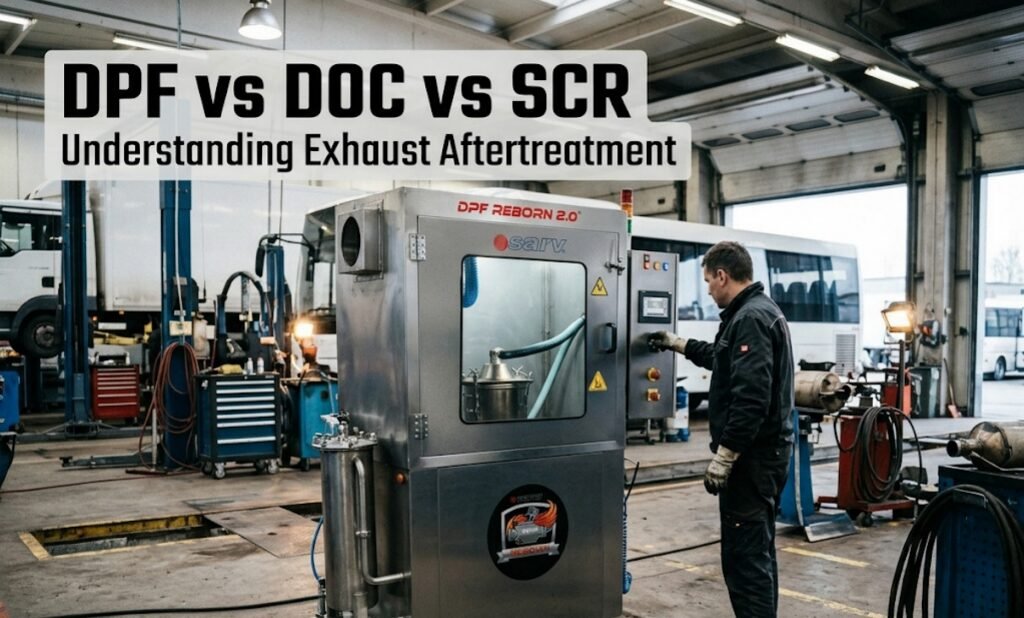
Modern BS6 and Euro-6 diesel vehicles rely on advanced exhaust aftertreatment systems to cut harmful emissions without sacrificing engine durability. For workshop owners, diesel technicians, and fleet managers, understanding DPF vs DOC vs SCR—and how a specialized dpf cleaning solution keeps particulate filters performing reliably—is essential for accurate diagnosis and profitable service operations.
When a dashboard warning light appears or a truck drops into limp mode, misdiagnosing which component is clogged or malfunctioning wastes hours and frustrates customers. In this practical guide, we break down what each unit does, why DPFs clog most often, how professional DPF Cleaning Solution works, and what to consider when choosing workshop equipment in India.
Why Modern Diesel Vehicles Need Three Aftertreatment Components
Diesel combustion produces different types of pollutants at the same time: unburned hydrocarbons, carbon monoxide, solid particulate matter (soot), and nitrogen oxides (NOx). Because no single filter or catalyst can handle all of these gases and particles together, manufacturers arrange three specialized modules along the exhaust line:
- DOC (Diesel Oxidation Catalyst): Converts gaseous carbon monoxide and hydrocarbons into harmless carbon dioxide and water while generating heat for downstream components.
- DPF (Diesel Particulate Filter): Physically traps solid black carbon soot and non-combustible ash inside a porous honeycomb substrate.
- SCR (Selective Catalytic Reduction): Uses Diesel Exhaust Fluid (DEF / AdBlue) to convert harmful nitrogen oxides (NOx) into harmless nitrogen and water vapor.
Together, these three units allow heavy trucks, buses, LCVs, and passenger diesel cars to meet strict emission norms on Indian highways and city routes.
DPF vs DOC vs SCR: Side-by-Side Comparison
Understanding how each component differs makes troubleshooting much faster in a busy service bay:
| Feature / Function | DOC (Diesel Oxidation Catalyst) | DPF (Diesel Particulate Filter) | SCR (Selective Catalytic Reduction) |
| Primary Target | Carbon monoxide (CO) & hydrocarbons (HC) | Solid particulate matter (soot & ash) | Nitrogen oxides (NOx) |
| How It Works | Chemical oxidation over a precious-metal catalyst | Physical wall-flow filtration through porous channels | Chemical reduction using injected DEF (urea solution) |
| Main Clogging / Failure Risk | Oil contamination, thermal overheating, fuel poisoning | Soot overload from short trips & non-combustible ash buildup | DEF crystallization, faulty dosing injector, NOx sensor faults |
| Routine Maintenance Need | Low; usually lasts long if engine runs clean | High; requires regeneration and periodic off-vehicle cleaning | Regular DEF refills and dosing/sensor inspection |
Deep Dive: How Each Component Works in the Exhaust Line
1. DOC (Diesel Oxidation Catalyst)
Positioned closest to the engine turbocharger outlet, the DOC is a flow-through honeycomb coated with platinum and palladium catalysts. As hot exhaust gases pass through, the DOC oxidizes carbon monoxide and unburned fuel vapors. Equally important, during active regeneration, extra fuel injected into the exhaust reacts inside the DOC to raise exhaust temperatures—helping burn off accumulated soot inside the DPF located directly behind it.
2. DPF (Diesel Particulate Filter)
Unlike the flow-through DOC, a DPF uses alternating plugged channels that force exhaust gas through porous ceramic walls. Clean gas exits out the back while microscopic soot particles stay trapped inside. Over time, soot burns away during regeneration, leaving behind non-combustible mineral ash from engine oil additives. Because ash never burns off, every DPF eventually requires thorough dpf cleaning to restore proper exhaust flow.
3. SCR (Selective Catalytic Reduction)
Located downstream of the DPF, the SCR catalyst reduces NOx emissions. A dosing module sprays a precise mist of DEF (aqueous urea) into the hot exhaust stream, converting into ammonia that reacts inside the SCR catalyst to form nitrogen and water. While the SCR handles gases rather than solid soot, a clogged or damaged DPF upstream can disrupt exhaust temperatures and trigger secondary SCR or NOx fault codes.
For further regulatory and engineering background on heavy-duty diesel emission control systems, workshops can consult technical standards from the Central Pollution Control Board (CPCB) India and the U.S. EPA Diesel Emission Standards Reference Guide.
Why DPFs Clog More Frequently Than DOC or SCR Units
In day-to-day Indian fleet and commercial operations, the DPF is the component that demands the most hands-on workshop maintenance. Common causes of premature DPF blockage include:
- Low-speed city traffic and extended idling: Exhaust temperatures remain too low for passive regeneration to clear soot naturally.
- Accumulated engine oil ash: High-mileage engines gradually deposit solid ash that fills filter cells permanently until flushed out.
- Upstream engine faults: Leaking fuel injectors, worn turbo seals, boost pressure leaks, or faulty EGR valves generate excessive smoke that overloads the DPF rapidly.
- Interrupted regeneration cycles: Switching off vehicles repeatedly while active regeneration is running leaves partially burned soot packed inside the filter.
How a DPF Cleaning Solution and DPF Cleaning Machine Restore Filter Flow
When dashboard warning lights persist or back pressure exceeds safe limits, basic fuel additives rarely clear packed ash. Professional workshops use a dedicated dpf cleaning solution paired with an automated DPF Cleaning Machine to restore filter permeability safely.
Here is why combining the right dpf cleaner chemistry with controlled machine flushing works effectively:
- Deep pore penetration: A formulated dpf cleaning solution softens baked carbon soot and breaks down oily residue inside microscopic ceramic pores without eroding the precious-metal washcoat.
- Bidirectional / reverse flushing: Machine-controlled water and air pulsing pushes loosened soot and mineral ash backward out of the inlet channels rather than forcing debris deeper.
- Complete hot-air drying: Integrated drying removes trapped moisture before reinstallation, protecting the substrate from thermal shock when hot exhaust gases hit the core.
- Measurable flow verification: Technicians can verify back-pressure recovery before and after cleaning, giving fleet customers clear proof of restored performance.
Evaluating a DPF Cleaning Machine in India: Buyer Checklist
As BS6 vehicles cross higher mileage milestones, demand for dpf cleaning machine in india solutions continues to expand across transport hubs, authorized service centers, and multi-brand garages. When comparing DPF cleaning machine price/manufacturer options, evaluate these practical criteria:
- Multi-vehicle adapter compatibility: Ensure the system accommodates passenger cars, LCVs, and heavy-duty truck or bus filters with quick, leak-free clamping.
- Cycle automation and safety controls: Look for programmable wash, rinse, and hot-air drying stages that reduce operator error.
- Stainless-steel tank and pump durability: Corrosion-resistant construction ensures long service life when working with heated cleaning solutions daily.
- Consumables and service support: Confirm local availability of the dpf cleaning solution, filtration cartridges, spare seals, and responsive manufacturer technical support.
Building a High-Return Commercial Workshop Setup
Workshops serving commercial fleets and multi-brand diesel owners achieve stronger bay utilization when emission maintenance is integrated with core mechanical services. Alongside emission equipment, high-volume service centers commonly invest in wheel alignment/tyre changer/lifts to handle heavy-duty lifting, suspension geometry, and tyre servicing—supported by bulk garage/tyre tools that keep every technician bay equipped without workflow delays.
Practical Diagnostic Tips Before Cleaning Any DPF
- Always scan DOC and SCR parameters alongside DPF pressure: A faulty temperature sensor or upstream injector leak will quickly re-clog a freshly cleaned DPF.
- Inspect the ceramic core visually: Cracked, melted, or oil-soaked substrates cannot be saved by cleaning and require replacement.
- Document before-and-after differential pressure: Sharing measurable test numbers builds immediate trust with fleet managers and transport owners.
Conclusion
Understanding DPF vs DOC vs SCR helps technicians pinpoint exhaust faults accurately instead of guessing between catalysts, sensors, and particulate filters. While the DOC and SCR manage gaseous emissions, the DPF captures solid soot and ash that eventually require structured off-vehicle care using a safe dpf cleaning solution and professional equipment.
Ready to upgrade your emission service bay? Request machine specifications and pricing directly on our DPF Cleaning Machine page today.
Visit our DPF Cleaning Machine category page to request a quote, compare machines.
Frequently Asked Questions (FAQs)
What is the main difference between DPF, DOC, and SCR in diesel vehicles?
The DOC oxidizes carbon monoxide and hydrocarbons and helps generate heat, the DPF traps solid soot and ash particles, and the SCR uses DEF (AdBlue) to reduce nitrogen oxide (NOx) emissions.
Can a DPF cleaning solution be used to clean a DOC or SCR unit?
A DPF cleaning solution is specifically formulated to loosen soot and ash inside wall-flow particulate filters. While DOC units occasionally accumulate light soot, SCR catalysts rely on DEF dosing and should not be flushed with standard DPF chemicals unless approved by the equipment manufacturer.
Why does a DPF still get clogged even if the vehicle runs active regeneration?
Active regeneration burns off carbon soot, but it cannot burn away non-combustible mineral ash from engine oil additives. Over high mileage, this ash fills the filter channels and requires professional DPF cleaning.
What should buyers look for when comparing DPF cleaning machine price and manufacturer options in India?
Buyers should evaluate supported filter sizes (car, LCV, and heavy truck/bus), automated wash and hot-air drying cycles, stainless-steel build quality, DPF cleaning solution availability, and after-sales service support.
How can workshops increase revenue alongside DPF cleaning services?
Workshops serving diesel fleets often combine DPF cleaning with wheel alignment, tyre changers, lifts, and bulk garage or tyre tools to offer complete commercial vehicle maintenance under one roof.